


Scapular Dyskinesis, Thoracic Spine Mobility, and Posture in Baseball & Softball Athletes
- Aug 13
- 8 min read
Kathy Ryan-Ceisel, PT MHS | Algonquin Sports PT
Overhead Throwing Expert-Athletic Edge and Wellness
Why Your Athlete’s Shoulder Evaluation Should Include More Than the Shoulder!

Most athletes, parents, and coaches understand that a healthy throwing arm needs adequate mobility, strength, and stability to perform at a high level. But there is another important piece of the evaluation that is often overlooked: the scapula, thoracic spine, and overall posture.
These areas are more complex and may be harder to understand, but they play a critical role in how an athlete throws, absorbs force, transfers energy, and ultimately protects the shoulder and elbow.
For throwing athletes, the shoulder does not work in isolation.
🔄️The Scapula: The Foundation of the Throwing Arm

The scapula, commonly called the shoulder blade, is a triangular-shaped bone that sits on the back of the rib cage. Unlike the shoulder joint, the scapula does not have a traditional bony joint connecting it to the rib cage. Instead, it glides across the thoracic spine and rib cage, moving up and down, forward and backward, and rotating as the arm moves. This mobility is essential for throwing.
The scapula serves as an important connection between the powerful movements of the lower body and the throwing arm. During an efficient throw, force begins with the athlete's interaction with the ground and is transferred through the legs, hips, pelvis, and trunk before reaching the scapula and shoulder.
This is often referred to as the kinetic chain.
Think of Throwing as a Chain
A simplified throwing sequence looks like this:
Ground → Legs → Hips → Trunk → Scapula → Shoulder → Elbow → Wrist → Ball
If one link in that chain cannot move or stabilize appropriately, another area may have to compensate. Research has demonstrated the significant contribution of the lower body and trunk to throwing mechanics, while the muscles surrounding the scapula and trunk play an important role in controlling and decelerating the arm after ball release. In other words, the scapula is not just along for the ride—it helps create an efficient platform for the throwing arm and helps control the tremendous forces generated during throwing.
👉The Scapula: Both Stable and Mobile
One of the most remarkable characteristics of the scapula is that it must perform two seemingly opposite jobs:
It must be stable enough to provide a foundation for the arm while remaining mobile enough to allow the arm to move through a tremendous range of motion.
During throwing, the scapula must coordinate with the humerus and thoracic spine throughout the entire throwing motion. During the early phases of the throw, the scapula moves into a position that helps prepare the arm for the cocking phase. As the athlete accelerates toward ball release, the scapula rapidly moves and rotates to help transfer energy and control the arm. It also needs to rotate and tilt appropriately as the arm moves overhead.
The Golf Tee Analogy
Think of the scapula as a golf tee and the head of the humerus as the golf ball.

If the tee is stable and positioned appropriately, controlling the golf ball becomes much easier. If the tee is moving all over the place, controlling the ball becomes much more difficult. The same concept applies to the throwing shoulder.
A stable, well-positioned scapula provides a better foundation for the humeral head to move efficiently.
🎯What Controls the Scapula?
The scapula has an extensive muscular attachment system, with approximately 17 muscles attaching directly to it. These muscles help position, stabilize, rotate, and control the scapula during movement.

This includes muscles such as:
Serratus anterior
Trapezius
Rhomboids
Levator scapulae
Pectoralis minor
Latissimus dorsi
Rotator cuff muscles
Biceps
The rotator cuff is a group of four muscles whose origins attach directly to the scapula (shoulder blade) and insert into the upper arm bone (humerus). They act as a vital stabilizing unit that holds the shoulder joint in place during movement. Because so many muscles influence scapular position, changes in muscle strength, endurance, flexibility, or coordination can affect how the scapula moves. This altered movement pattern is commonly referred to as scapular dyskinesis.
🩻What Is Scapular Dyskinesis?
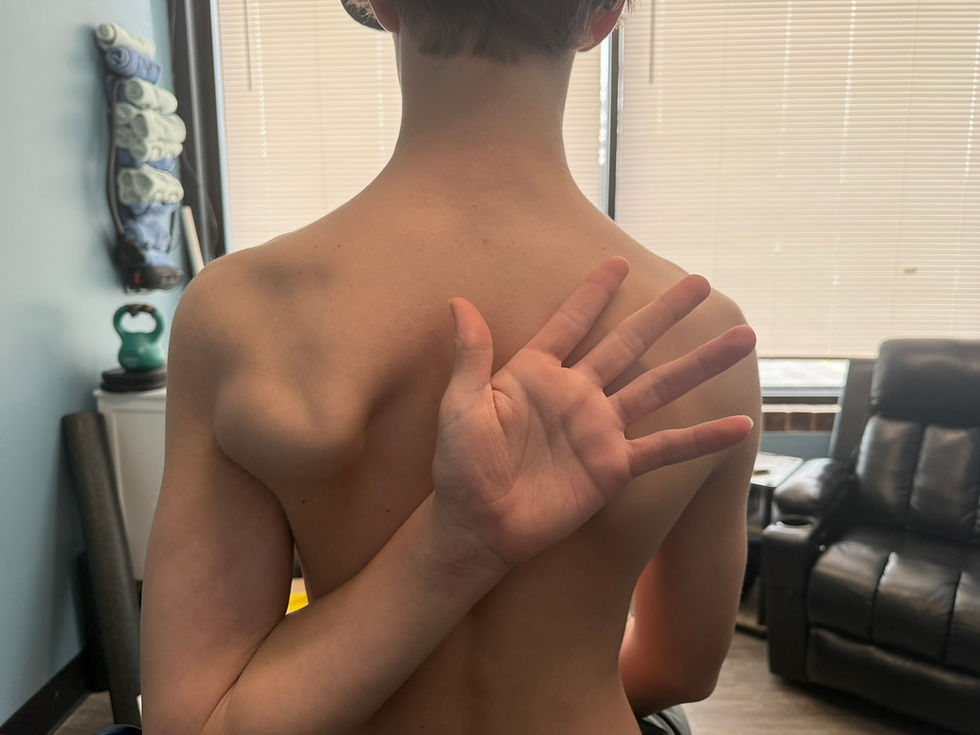
Scapular dyskinesis describes an alteration in the normal position or movement of the scapula. It may become noticeable when the shoulder blade appears to protrude from the rib cage, sometimes described as "winging." Importantly, scapular dyskinesis is not necessarily a diagnosis or an injury by itself. Some athletes have observable scapular movement abnormalities without pain.
However, altered scapular mechanics may be associated with decreased shoulder function and may contribute to increased stress on the throwing arm in some athletes. Research has suggested that collegiate baseball pitchers with dominant-arm scapular dyskinesis may have an increased risk of throwing-related shoulder injury. That makes scapular assessment an important component of a comprehensive baseball and softball athlete evaluation.
Signs and Symptoms of Scapular Dyskinesis
Possible signs and symptoms include:
Pain or tenderness around the shoulder blade
Pain with overhead activity
Snapping, popping, or grinding with shoulder movement
Decreased shoulder or arm strength
Shoulder fatigue during throwing
Changes in posture
One shoulder appearing lower than the other
Visible asymmetry between the shoulder blades
The shoulder blade protruding or "winging"
Difficulty maintaining proper shoulder mechanics during throwing
Again, an athlete does not necessarily need to have pain to have altered scapular mechanics. That is why assessment is important before symptoms become a problem.
🦾Why Posture Matters for Throwing Athletes
The scapula does not move independently of the rest of the body. Scapular position is heavily influenced by the position and mobility of the thoracic spine and rib cage.
Consider how many young athletes spend their day:
Sitting at school
Looking down at a phone
Working on a computer
Sitting in the car
Playing video games
Completing homework
Then practicing or playing their sport
Hours of sustained sitting can contribute to poor postural habits and reduced thoracic mobility.
A common posture includes:
Forward head → Rounded shoulders → Increased thoracic flexion → Altered scapular position
The problem isn't simply that the athlete "looks slouched." The position of the thoracic spine can directly influence how the scapula moves and how effectively the shoulder can elevate overhead.
📢Thoracic Spine Mobility and Overhead Throwing
The thoracic spine, or mid-back, needs adequate mobility to allow the scapula to move appropriately. If an athlete lacks thoracic extension or rotation, the scapula may not be able to rotate, tilt, and position itself efficiently during overhead movement.
That can affect the athlete's ability to:
Reach overhead
Get into the appropriate throwing position
Separate the upper and lower body
Rotate efficiently
Generate and transfer force
Maintain shoulder mechanics
Control the arm during deceleration
For a throwing athlete, even small limitations can matter. One study found that a 5-degree loss of shoulder elevation was associated with an increased risk of elbow injury in professional baseball pitchers. While this does not mean every athlete with limited motion will sustain an injury, it highlights the importance of adequate mobility throughout the throwing system.
The takeaway is simple:
If the thoracic spine cannot move, the shoulder and scapula may have to make up the difference.
⚾🥎Baseball and Softball Are Asymmetrical Sports
Baseball and softball athletes spend thousands of repetitions performing movements primarily on one side.
They throw from one side.
They typically bat from one side.
They may field and reach predominantly in certain directions.
They rotate repeatedly in the same direction.
You cannot perform thousands of right-handed throws and swings while performing very few movements in the opposite direction and expect the body to remain perfectly symmetrical.
Adaptation is normal.
The goal is not necessarily to make an athlete perfectly symmetrical. Instead, we want to identify whether an asymmetry is creating a mobility, strength, movement, or performance limitation.
This is particularly important during the offseason when there is an opportunity to address movement deficits before the demands of another competitive season begin.
🚦How Should the Scapula Be Evaluated?
A proper scapular evaluation should look at the athlete both at rest and during movement.
At Rest, we assess:
Overall posture
Shoulder height
Scapular position
Thoracic spine position
Rib cage position
Side-to-side differences
Muscle symmetry
During Movement, we assess:
Scapular upward rotation
Scapular retraction and protraction
Scapular control
Thoracic mobility
Shoulder range of motion
Strength and endurance
Movement quality
Compensation patterns
We also want to observe what happens when we add resistance or sport-specific demands.
Remember:
Even a 5-ounce baseball is a load.
If an athlete has a movement deficit without a ball in their hand, adding thousands of throwing repetitions during a season may amplify that problem.
🏋️♂️How Do You Improve Scapular Function?
Scapular training can be surprisingly complex.
The goal isn't simply to tell an athlete to "squeeze your shoulder blades together." In fact, the scapula needs to move in multiple directions during throwing. A trained physical therapist or sports rehabilitation professional can determine whether the athlete needs improvements in:
Thoracic mobility
Shoulder mobility
Scapular strength
Scapular endurance
Motor control
Postural awareness
Rotator cuff function
Core strength
Rib cage mobility
Sport-specific movement patterns
The stronger muscles of the chest, shoulders, back, and arms can easily dominate weaker or poorly coordinated scapular stabilizers.
Therefore, more exercise is not always the answer. The right exercise for the right deficit is what matters.
💁♀️Practical Tips for Throwing Athletes
Here are some simple ways athletes can begin improving their movement quality:
1. Start With Alignment
Think:
Alignment → Mobility → Stability → Strength → Performance
Stand tall and maintain a neutral spine rather than allowing the head and shoulders to continually fall forward.
2. Improve Thoracic Mobility
Use exercises that encourage thoracic extension and rotation.
A foam roller can be useful for thoracic mobility, particularly when combined with active movement.
3. Train Both Pushing and Pulling
The scapula needs to control both pushing and pulling movements.
Examples include:
Push-ups
Rows
Pull-downs
Pull-ups
Planks
Bear crawls
4. Use Different Hand Positions
Changing between palm-up, palm-down, and neutral grips can change which muscles are emphasized during an exercise.
5. Build Scapular Endurance
Throwing is not simply a strength activity.
The scapular muscles must repeatedly control the arm over the course of a game, practice, and season.
6. Don't Ignore the Mid-Back
Throwers often develop mobility restrictions in the directions opposite their repetitive throwing and hitting movements.
Thoracic extension and rotation should be assessed rather than assuming the shoulder is the only source of restricted motion.
7. Don't Forget to Breathe
Breathing mechanics influence rib cage movement, which can influence thoracic mobility and scapular mechanics.
Good movement starts with the entire system—not just the shoulder.
8. Address Side-to-Side Differences
If one side is significantly weaker or less mobile, individualized training may be necessary.
This is where an athlete-specific assessment becomes particularly valuable.
⭐The Bigger Picture: Don't Just Assess the Arm
A healthy throwing arm isn't simply about having a strong rotator cuff.
The shoulder is part of a larger movement system.
The legs create force.
The hips and trunk transfer that force.
The thoracic spine provides mobility.
The scapula provides a mobile and stable foundation.
The shoulder transfers the energy to the elbow and wrist.
And the entire system must work together to produce and control the throw.
That's why an offseason baseball or softball evaluation should look beyond the shoulder and include the scapula, thoracic spine, posture, mobility, strength, and overall movement mechanics.
If an athlete cannot get into the correct position, adding strength may simply make them stronger in a poor position.
That is why our approach is:
Alignment before mobility.
Mobility before stability.
Stability before strength.
Strength before performance.
The goal isn't simply to make an athlete stronger.
The goal is to help them move better, perform better, and build the physical capacity necessary to handle the demands of their sport.
📅Is Your Baseball or Softball Athlete Ready for the Next Season?
The offseason is the perfect time to identify movement limitations before throwing volume increases again.
At Athletic Edge and Wellness, our sports physical therapy approach looks beyond the painful body part. We evaluate the athlete as a complete movement system to identify limitations in mobility, strength, stability, mechanics, and movement that may affect performance or contribute to injury risk.
Don't wait for shoulder or elbow pain to tell you something is wrong.
A preseason or end-of-season movement assessment can help identify problems before they become bigger problems.
Know your body. Own your performance.


Comments